Information Request documents reveal Canada is building a mammoth AI Data Surveillance Infrastructure through Cohere with Corporate Giants
Commentary by Dan Fournier, published Wednesday, May 27, 2026 at 5:36 EDT.

No other journalist in Canada has published as much revelatory information about this colossal AI-based Digital Control Surveillance grid that is currently being assembled in our country. Nobody. Countless hours of research, corresponding, writing, and proofreading goes into my articles, investigatory series, free eBooks, and podcasts. I would therefore greatly appreciate your financial support so that I can continue to bring you such in-depth quality work you will scarcely find anywhere else. As an independent investigative journalist I get paid peanuts on this platform compared to what propagandists at the CBC, CTV, and Global mainstream outlets receive. Unlike them, I am one of your only sources of unvarnished truth. I have no sponsors and am beholden to no one but God. I toil over this work mostly out of love, passion, sense of duty, patriotism, and to help restore my native Canada to its former glory. I am often tempted to lay down my pen in exchange for a more peaceful and worry-free life. So, please see the links at the bottom of this post on how you can show your support and appreciation for my work. Thank you!
Quick Introduction and Recap
This will serve as a follow-up article to my previously published Meet Cohere – Palantir’s Canada AI Partner for Mass Surveillance on Canadian Citizens & Businesses piece.
If you haven’t yet read it, I strongly encourage you do to so since what is being built with have tremendous implications on your privacy, security, and rights in the years to come.

ATI Requests to the Canadian Government about Cohere
There currently exists many Access to Information (ATI) requests regarding Cohere.
I had originally performed a search on Cohere which rendered 20 results. I thus requested nearly all of these previously requested documents which are available for any Canadian to who seeks to obtain them.
What follows are some notable highlights from 15 existing ATI request documents which I have received thus far [with emphasis added for notable points.
Disclaimer: as this information has already been released (and redacted); it is in the public domain and is thus considered fair use for the purposes of this reporting.
A-2024-01025 (Feb. 2026, 2 pages): One Pager on Cohere:
Cohere had initially raised a total of $971.25 million in funding trough 7 rounds.
In July 2024, the company was already valued at US$5.5 billion.
Investors included: NVIDIA, Salesforce Ventures, Cisco Investments, Export Development Canada (EDC), and Canada’s Public Sector Pension Investment Board.
So, yes they are using public sector pension funds to invest in Cohere.
Key partnerships with major U.S.-based cloud providers:
many other providers are REDACTED
Cohere has partnerships with consulting firms McKinsey & Company as well as Accenture (a notorious surveillance company and WEF partner).
These should be obvious RED FLAGS.
A-2025-01507 (Feb. 2026, 5 pages): Memorandum of Understanding between ISED and Cohere, announced on August 19, 2025
An August 14, 2025 email confirms the MOU between Aidan Gomez (CEO of Cohere), Evan Solomon (Canada’s Minister for AI and Digital Innovation), and Joel Lightbound (Minister of Government Transformation, Public Works and Procurement), as signed by these three parties.
As per the MOU, they will “explore commercial opportunities across the AI ecosystem,” which includes AI LLMs “across the GC” (GC means the Government of Canada).
The use of the term “across” implies the inclusion of well over a hundred federal Departments and Agencies.
It includes both in civilian cases as well as in “national defense contexts, particularly in meeting the nation’s international commitments in mutual defense agreements.”
Note: while these are not specifically stated, they could include international commitments such as those I outlined in one of my previous articles.
“Specific Areas of Opportunities for Commercial Collaborations” are all REDACTED as are their “Forms of Cooperation.”
This is also quite suspect, as if it is of a commercial nature, I don’t see why it should be redacted; perhaps the “specific areas” could include AI-based surveillance, but it is difficult to know for certain.
Secretively, the MOU states that there shall be “no public announcement (whether in the form of a press release or otherwise”) about it.
Why?
This is highly suspect, as it implies they have something to hide.
A-2025-00997 (Dec. 2025, 6 pages): Government of Canada Memorandum of Understanding with Cohere
This release consists of a document from Innovation, Science and Economic Development Canada (ISED) and a MOU between the Government of Canada and Cohere.
The “Objectives” of the MOU are all REDACTED, as are the “Specific Areas of Opportunities for Commercial Collaborations” and “Forms of Cooperation.”
What is most notable, however, is that the Summary section states that “the MOU seeks to further maximize these activities by coordinating collaborative opportunities to deploy AI across GC operations”
This implies that Cohere will be involved and most likely have access to data found in government databases for all its federal departments.
This should scare Canadians, as a private company, Cohere, who appears to be sharing information with U.S.-based Palantir, will have access to all this data.
A-2025-01015 (Dec. 2025, 7 pages): Overview of Cohere Deal
What is most notable about this release is the “Agreement Date” (with Cohere) which is fixed from March 10, 2025 until April 30, 2049.
Until 2049 folks! This time period, 24 years, is nearly a quarter of a century. Has the Canadian Government ever signed an MOU to obtain the services of a private company for this long of a period in the past? Strange.
Is it a coincidence that this year (2049) nearly coincides with Canada and the OSFI’s 2050 “Net-zero 2050 (1.5℃)” target?
In other words, will the AI ecosystem encompass tracking Canadian businesses so that they adhere to these net zero guidelines?
The “Agreement Value” between the Government of Canada and Cohere is set at $240,000,000 at the time of this agreement.
But since their agreement is set to last until 2049, how many more millions (if not billions) will be funneled from Canadian taxpayers to Cohere during that period?
The release also indicates “Cost-sharing” between the parties for the “total project costs of $724,750,000” with two sections REDACTED.
A-2025-00210 (Nov. 2025, 20 pages): Briefing notes, reports, risk impact assessments and privacy impact assessments from January 1, 2024, to July 10, 2025 related to Deputy Prime Minister’s announcement of $240 million for Cohere to scale-up AI compute capacity
This release provides information about Canada’s multi-billion dollar investment in “AI compute capacity,” as well as “cutting-edge AI infrastructure” in the context of “Canadian Sovereign AI Strategy.”
It also mentions the Pan-Canadian Artificial Intelligence Strategy, and the Canadian Artificial intelligence safety institute – which is part of a larger network of “safety institutes”.
Wikipedia – Artificial intelligence safety institute (a network of AI Safety Institutes, comprising institutes from the UK, the US, Japan, France, Germany, Italy, Singapore, South Korea, Australia, Canada and the European Union).
Youth AI Safety Institute (see also the ReclaimTheNet.org article ‘AI Safety Institute Debuts with Big-Name Backers and a Censorship Agenda’).
So, again we have large-scale international collaboration to keep us “safe” which is codeword for AI-based censorship.
The release also mentions Bill C-27 (the Artificial Intelligence and Data Act) which seems to have stalled in the House of Commons since April of 2023 – but is likely to be replace with the new AI Bill.
A-2024-01335 (Nov. 2025, 7 pages): Records regarding the November 18, 2024 meeting between Matthew O’Connell and Cohere Inc.
This release package also mentions Bill C-27 (the Artificial Intelligence and Data Act) and how it will “set in place guardrails to protect Canadians from risks due to AI systems.”
Humm, I wonder if it considers risks associated with Cohere sharing very personal and private data on Canadian individuals and businesses with its U.S. Partner Palantir (and Oracle, Google, Microsoft, Amazon, and others)?
It also refers to the Canadian Artificial intelligence safety institute receiving an initial budget of $50 million amidst a $2.4 billion (2024) package to “secure Canada’s AI advantage with funding for infrastructure, start-ups, researchers, safety research, and regulation.”
A-2025-00077 (Nov. 2025, 10 pages): Request for July 2025 briefing documents: 26834 (Sovereign AI in Canada) and 26837 (Canada-Cohere MOU)
request not yet received
A-2024-01089 (Oct. 2025, 8 pages): Written submissions made by Cohere to the Consultations on Artificial Intelligence Compute held between June 26, 2024, and September 6, 2024
This appears to be an internal document of Cohere which is highly REDACTED with “Business Restricted – HIGHLY CONFIDENTIAL” written on its first page.
It seems to involve a discussion with Cohere’s partner Oracle (since “Oracle Cohere” appears in the header section of many of its pages).
It also references Cohere’s partnership with CoreWeave, stating that “CoreWeave is ready to partner with Cohere, the Canadian government, and other leading AI innovators in Canada and establish [REDACTED]”.
It mentions that CoreWeave “has the experience to expand globally” and has “established a European headquarters in the UK and open data centers in London, Sweden, and Barcelona, with more on the way.”
Moreover, “CoreWeave has experience collaborating with government leadership in the United States and Europe, and they are excited to build a partnership with Canada…”
In other words, CoreWeave collaborates (which most likely implies sharing data) with the U.S. Government and governments in Europe.
A-2024-01333 (Aug. 2025, 4 pages): Records related to the December 12, 2024 meeting between ISED’s Surdas Mohit and Samir Chhabra and Cohere Inc.
This release relates to a meeting organised by Samir Chhabra of ISED with an unspecified member of Cohere.
No details of the meeting are given, but there is an email from Aidan Peppin who is the ‘UK & EU Lead for Government Affairs and Public Policy’ (and who previously worked at Cohere earlier in 2024) to Mohit and Chhabra from ISED that was sent after the meeting.
It seems that the bulk of the meeting discussion focused on AI security issues, including “AI biorisk” – whatever that means.
The email had a section titled “Thoughts on safety test cases” with two notable such “use cases.”
The first relates to Disinformation where it is stated: “For example, what does a use case for LLMs augmenting or amplifying disinformation look like, and how can we test if our model(s) could be used for such a use case?” While this could be interpreted as using Cohere’s LLMs to track misinformation, it seems to imply that their models could be use to perform such actions; in such a scenario, that would be a deceptive one that would certainly prove immoral, unethical, if not illegal, should it be used on the Canadian public.
The second use case relates to ‘Cyber fraud’ where it is stated “For example, what does a use case for LLMs augmenting or amplifying cyber fraud look like, and how can we test if our model(s) could be used for such a use case?” Again, either this is a very poor choice of words on the part of Peppin, the former Cohere employee, or it shows potential for malicious intent and [illegal?] use of their systems.
A-2024-01332 (June 2025, 7 pages): Records regarding the meeting between Cohere and ISED’s Alexandra Dostal and Samir Chhabra on January 14, 2025
This release is particularly revealing.
First, it shows that Mèlika Carrol, acts as Head of Global Government Affairs and Public Policy at Cohere.
While it is not nessearily unusual for companies to have such a position to facilitate communication and collaboration (or lobbying) with the government, her LinkedIn page says she is based in Washington D.C., she is a registered lobbyist, and also serves on the board of directors of Reliability First – one of the six Federal Energy Regulatory Commission (FERC)-approved regional entities responsible for “ensuring the reliability of the North American Bulk-Power System.”
Also, Carrol was on a December 16, 2025 panel where OpenAI & Cohere Policy Chiefs Debate Canada’s AI Regulation Framework (AIDA). The talk focused on the finalisation of Canada’s “AI regulatory framework” through its Artificial Intelligence and Data Act (AIDA) (note: this act refers to Bill C-27 mentioned elsewhere in this post that remains dormant and will likely be replaced by an AI Bill). As they expect AIDA to “resurface in Parliament,” it will seek to establish risk-based AI oversight at the federal level with policies including “measures to address harmful content.” Furthermore, they discussed [AI] “governance frameworks” and Carrol talked a lot about having met with “regulators around the world” and largely how Cohere can develop tools to best serve their business customers. She sees Canada as having a “ticket” of being a major player in the “AI race” along with the U.S., China, and France. The OpenAi member of the panel mentioned that though Canada may pursue its own framework and regulatory approach, it must not forego interoperablility with the UK/EU/US systems. In other words, Canada would need to fall in line with the group.
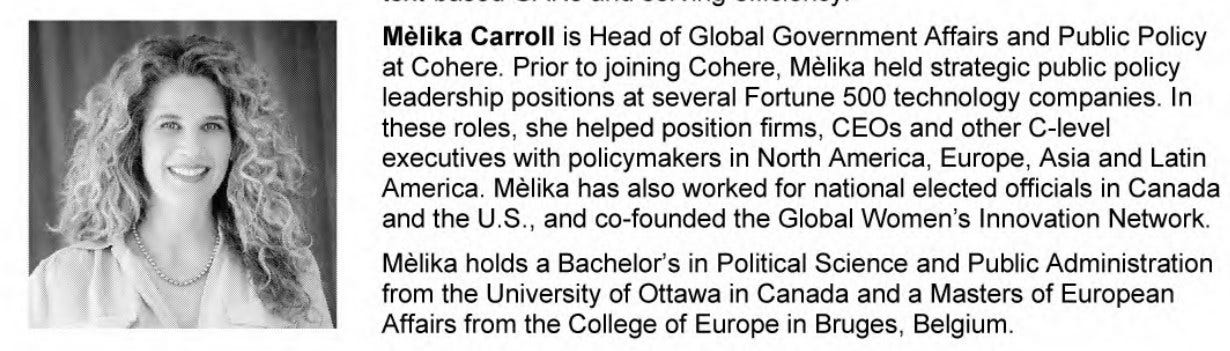
Notably, The release shows ISED openly asking for Cohere’s input on “AI regulation” and what “policy gaps” remain.
This shows that they are directly soliciting Cohere to help guide whomever will be drafting the upcoming AI-related bills for specific content.
Moreover, ISED also directly states: “Looking ahead, what would Cohere like to see from future AI regulation in Canada?”
The release also stated that Canada “remains committed to advancing AI as a priority for the G7,” and referred to the G7 Summit which was held in Kananaskis in June of last year with “international cooperation on AI.”
For more details on this G7 agreement, see Canada’s Implementing the G7 AI Adoption Roadmap information page.
This G7 agreement is noteworthy since I previously documented how this aligns with the United Nation’s Global Digital Compact and its inherent rights-stripping features.
The next very notable feature of this release includes an image reference to a partnership between Cohere and Canada’s largest commercial bank, Royal Bank of Canada (RBC). The image is from an official RBC news release (see also here and here) on the matter whose purpose is to “co-develop and securely deploy an enterprise generative AI (genAI) solution optimized for financial services” for a platform called “North for Banking” which will “will integrate with RBC’s and Cohere’s own proprietary foundation models.”
While financial institutions such as banks can certainly benefit from various AI functions, what is particularly worrisome here is that you have two private corporate entities that will be connecting their models together.
And RBC customers would have no way of knowing whether their financial data and personal information is being shared, tracked, or trace by Cohere and its customers and partners such as Palantir. I don’t personally bank at RBC, but this kind of agreement would scare the sh*t out of me!

A-2025-00174 (July 2025, 3 pages): Briefing Note 2025FIN039472 - Meeting with Cohere Chief Executive Officer
This is a Briefing Note addressed to Canada’s Minister of Finance (François-Philippe Champagne – who has never ever ever attended any highly secretive Bilderberg meetings, by the way) – for a backgrounder on Cohere’s CEO Aidan Gomez.
There is mention of funding for the “Cohere data centre project” by the Canadian government amidst its $2 billion Canadian Sovereign AI Compute Strategy.
A-2024-00571 (June 2025, 62 pages): Privy Council Office – Briefing notes: ‘’Meeting with Cohere’’ received on October 1, 2024...
This one is noteworthy since it is with the highly secretive Privy Council Office, containing 62 pages of information.
It has a memo to the Prime Minister (Justin Trudeau at the time) regarding his meeting with Cohere’s CEO, Aidan Gomez.
Bill C-27 (AIDA) is mentioned stating that Cohere has expressed “reservations” regarding how AIDA would affect its AI products, emphasising that B2B AI products should “be subject to lighter regulatory requirements under the Act” given that AIDA’s scope is “too broad” and “misaligned with international partners.”
This later part implies that Cohere seeks more coordination with “international partners,” likely with regards to procedures and data sharing.
There is also mention of a memo for the Prime Minister for a possible [government/private sector] “MEETING WITH CANADIAN BUSINESS LEADERS ON CYBERSECURITY,” asking if he will attend.
The meeting appears to be in reference to the ‘Fall 2024 Canadian Cyber Security Summit’.
From what I gather, it seems to specifically refer to a summit officially called ‘ISMG’s Cybersecurity Summit: Canada East’ held in Toronto on September 26, 2024. The release shows part of a PDF document for it, but I am unable to find it online. Topics include “Navigating New Cybersecurity and Privacy Laws in Canada” and “Harnessing AI in Cybersecurity” on its agenda.
Perhaps unrelated, but there was also an inaugural Toronto Cybersecurity Summit also held in Toronto the following month in July with a very extensive list of “Thought Leaders” and “Summit Delegates.”
The release also has mention of “Lessons Learned: Public-Private Engagement with the CSE” – which of course refers to Canada’s spy agency, the Communications Security Establishment Canada (CSE).
This is noteworthy because I already highlighted a connection and contract between the CSE and Cohere.
A-2024-00994 (June 2025, 15 pages): Meeting with Mr. Aidan Gomez, Cohere’s CEO & Co-Founder Cohere
This 15-page release largely shows the potential for Canada to become a global AI leader particularly in terms of AI Data Centres, listing numerous advantages and partners.
It sates (at the time) that Cohere is “by far the largest Canadian-based AI company.”
Cohere could “use its purchasing power to serve as the catalyst and anchor of a Canadian high-performance data centre(s), incentivizing private-sector compute providers to set up operations in Canada.
In other words, Cohere would serve as the “anchor” to attract [largely foreign] private partners to develop a massive AI Data Centre ecosystem in Canada. See two related images from this release below for specific names of Canadian and international participants.
Their proposal would use “[REDACTED] only” $2 billion [from] Canada’s AI Compute Access Fund in their budget.
Note that the choice word “only” in the context of $2 billion is somewhat odd.
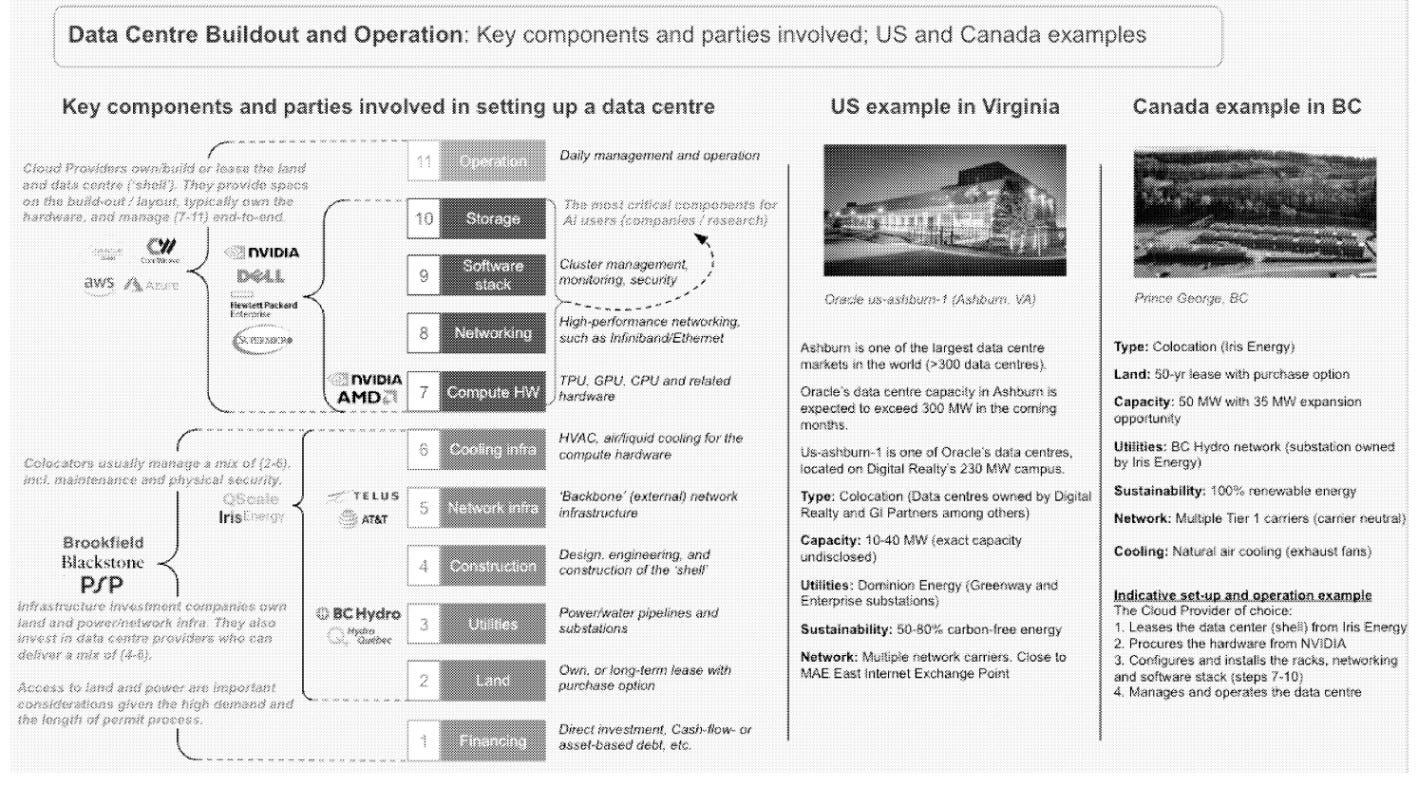
Above is a figure that appears in the release. Notice key participants that would be involved in the ‘Data Centre Buildout and Operation’ which includes Mark Carney’s Brookfield [Asset Management] and BlackRock – the largest asset management firm in the world with over US$14 trillion in assets under management. All the large U.S.-based cloud providers also figure among the key parties. In addition, BC Hydro and Hydro Quebec figure among the Canadian utility/energy companies for the operation.
And speaking of BlackRock, you should also be aware of recent comments from its Chairman and CEO Larry Fink (and Interim Co-Chair of the WEF) where he states that trillions of dollars will be needed to fund AI Data Centres and that these funds ought to come from Savings accounts and Pension accounts of citizens.

Another figure from the release shows the key players involved in the ‘Data Centre Buildout and Operation’ with Canadian telecom giants Bell, Telus, and Rogers as participants of the ‘Network Infrastructure’ component of the greater model. Note that combined, these three telecom giants command whopping 86.9% share of mobile subscribers in the Canadian market.
In other words, who is to say that Bell, Telus, and Rogers won’t share the data and communications to Cohere (and thus their business partners)?
After all, should Bill C-22 pass and become law, the infrastructure to collect a year’s worth of personal data and information on all Canadians would be in place.
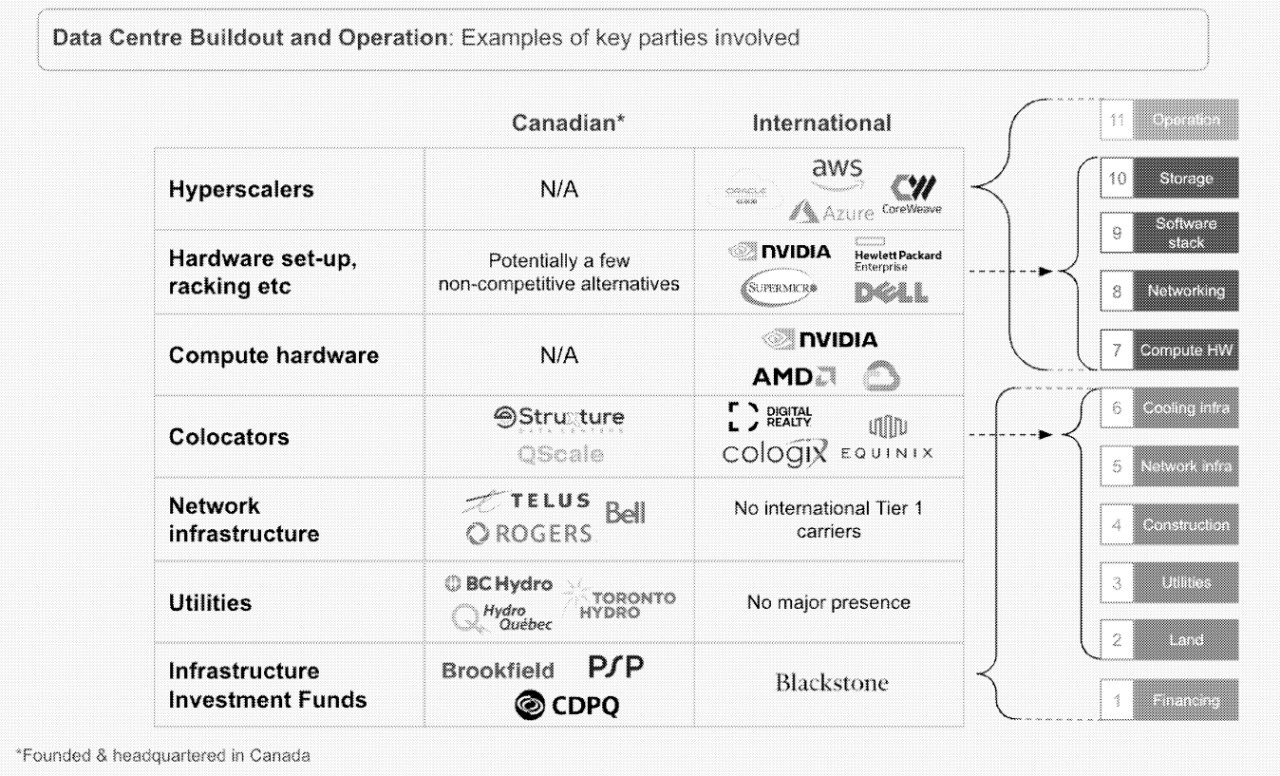
One should also observe “CDPQ” from the ‘Infrastructure Investment Funds” section of the above figure. CDPQ stands for Caisse de dépôt et placement du Québec which manages several public and parapublic pension plans and insurance programs in the Canadian province of Quebec. In other words, the CDPQ appears to be a designated investor and key partner in this ‘Data Centre Buildout and Operation’.
A-2024-01253 (April 2025, 3 pages): Meeting with Cohere
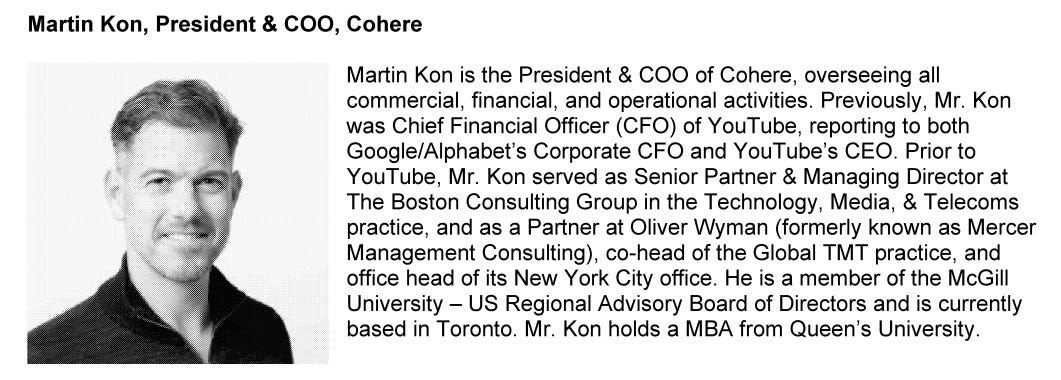
This release is about a meeting between the Deputy Minister of ISED (most likely Philip Jennings) and Cohere’s President and Chief Operating Officer (COO) Martin Kon.
The document mentions that AIDA (Bill C-27) is “designed to align with other jurisdictions, ensure consistent rules,” which suggests strong coordination with countries outside of Canada.
It also specifies who the President and Chief Operating Officer (COO) is at Cohere – namely Martin Kon (see image below for profile).
What is somewhat suspicious is that if you search for “Martin Kon” on www.cohere.com, nothing comes up.
And the same goes for the aforementioned Mèlika Carrol, who acts as Head of Global Government Affairs and Public Policy at Cohere.
Why? One would think that the profiles of those holding two such important positions for the company would be listed on their website; but they are not. Perhaps they are no longer employed by Cohere, but it is difficult to know for certain with this lack of transparency.
A-2024-00403 (Sept. 2024): Meeting with President of Cohere and Associate Deputy Minister
This release documents involves preparatory details for a meeting between ISED’s Deputy Minister (Simon Kennedy) and Cohere’s President and COO Martin Kon with one of its purposes being to discuss Cohere’s involvement in the Canadian AI ecosystem.
It states that Canada lags behind all G7 peers in terms of its “aggregate computing power” and that the country aims to leverage its existing foothold in AI.
A January 29, 2024 email addressed to Kennedy by Cohere’s CEO Aidan Gomez asserts how his company can help Canada secure “computing power” for its Canadian AI Sovereign Supercompute Strategy (AIS3).
Making Sense of the contents of these ATI Documents
The information above comes from merely 15 ATI documents that have been released.
There could be more ATI requests that are currently in the works, with more to come in the future – not only with regards to Cohere, but also about some of its key partners such as Palantir, Google, Amazon, Oracle, CoreWeave, and others listed and shown above.
There is a much larger AI puzzle at play here folks.
What I have presented above represents only a tiny fraction – perhaps only 5% of all the pieces to this mammoth AI Data collection, surveillance and infrastructure system being assembled in Canada, interconnected and interoperable with those of other countries.
The fact that major players such as BlackRock and Brookfield, the three largest telecom companies in Canada, and other significant participants are involved in this endeavour suggest that this is one formidable machine that will be difficult, but not impossible, to defeat.
There are undoubtedly countless other highly-revelatory morsels to be discovered and chewed on, should the Canadian public be inclined to inquire and dig deeper into them.
With this post along with my previous two articles and latest podcast, I have merely started to pull the rug and uncover the terrifying creatures that lurk thereunder.
I cannot do this alone folks.
Therefore, I am asking for you all to assume your part and inquire further in any way you can. That can take the form of:
calling or writing to your Member of Parliament to inquire more on these matters and to express your concerns;
to write to members of other federal or provincial departments on the matter;
sending email inquiries to these involved companies for comments and to show your objections;
to submit ATI requests – which I show you how to do below.
You can also share this information with friends and family members to bring about increased awareness on this issue of paramount importance. The more people know about this – whether they are Canadian, American, or a citizen of another country involved in this AI network – the more we will be in a position to resist it.
If this is not done collectively, I’m afraid that this AI Data Digital Panopticon with be the last nail in Canada’s coffin.
How to make more Access to Information (ATI) requests about Cohere, Palantir or others?
While this follow-up article largely focused on Cohere, more work and inquiries need to be done with regards to its partner Palantir (among many others) so as to obtain a more complete view of the companies operations, its private-sector corporate partners, and what data and information on Canadian individuals and businesses it may be using and sharing.
Any Canadian can make ATI requests. It’s always preferable to first search in order to see what may already be available. You can make these requests for free online, but they do ask you a bunch of personal data and questions. I personally prefer to print a PDF form, fill it in, and mail it to the appropriate ‘information and privacy coordinators by institution’. Note that using this method may entail a $5 fee – which you can simply include a $5 note along with your filled-in form in the envelope for your request.
I strongly encourage Canadians to partake in this process while it is still available to us. I get the feeling that they will be removing this “privilege” in the near future just like the Ontario government appears to be doing.
Support My Work
Who else brings you this kind of in-depth reporting? Please consider supporting my investigative efforts to bring you this valuable news.
Here are different ways you can financially support me:
Get a monthly subscription ($5/month) to my Substack
Get a yearly subscription ($50/year) to my Substack
Become a Founding Member ($100) to my Substack
If money is tight for you, you can simply get a free subscription (select “None”) to my Substack, and also follow me via:
My Substack feed: substack.com/@fournier

and on:
Disclaimer:
See the author’s About page for full disclaimer.
Without sounding dramatic, I think we are on the road to the destruction of humanity. I might be wrong, yet I feel that AI is a gateway to transhumanism.
"And speaking of BlackRock, you should also be aware of recent comments from its Chairman and CEO Larry Fink (and Interim Co-Chair of the WEF) where he states that trillions of dollars will be needed to fund AI Data Centres and that these funds ought to come from Savings accounts and Pension accounts of citizens." — I found this very disturbing! I feel like this is what is needed to wake up regular folk who don't see how them clamoring for more AI is how AI is going to steal their future away. AI will destroy the earth if it is not controlled expeditiously. Wonderful technology, but like the cell phone, it can be used to ensnare and entrap. https://unorthodoxy.substack.com/p/how-ai-will-destroy-the-earth